|
Applecross is a small remote Village in
northwest Scotland, 80 miles west of Inverness, 27
miles southwest of Torridon, popular for its
Mountain Road, Outdoor Activities,
Inn for Meals, Heritage Centre, and Views over
the Isle of Skye. The Peninsular is also known
as Applecross.
For Images on Mobile swipe right
Click on Map for area Attractions
Camping & Touring Parks in
area
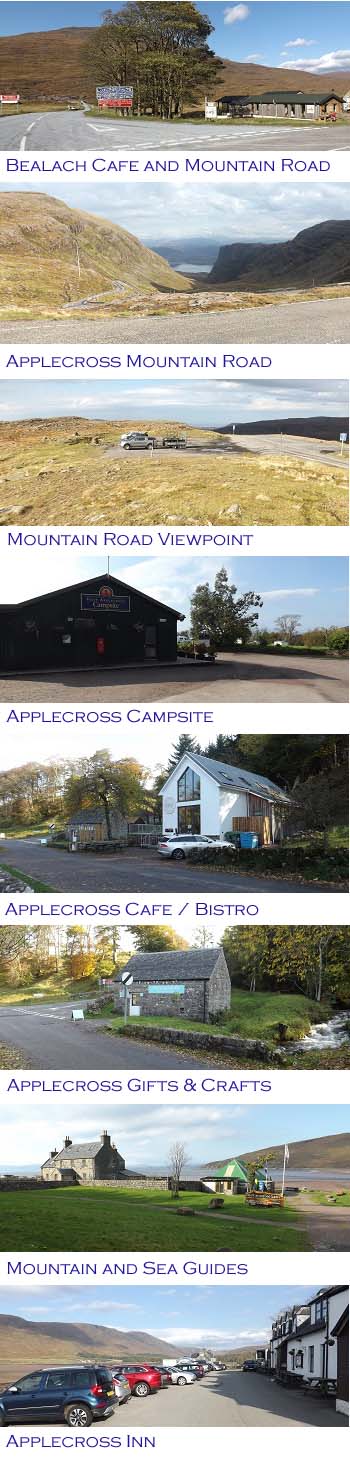
The image top right is of the Bealach Cafe
and Gallery at the start of the Mountain Road
to Applecross named Bealach na Ba / Pass of the
Cattle.
The image second top is looking back down
the Mountain Road at the steepest point. This
part of the road is real steep with hairpin
bends that have to be taken in second or first
gear.
If you have a large camper van or towing
caravan, it may be best to use the coastal road
to Applecross, although that is real steep and
narrow in places as well.
This road was made of Gravel in 1822 for
Cattle Drovers, had Cars racing over it in
1905, then had Tar laid on it in the 1960s.
The Viewpoint is at 2,053ft, close to the
top of the top of the 2,539ft / 774m Sgurr a'
Chaorachain mountain, from where there are even
more dramatic views if you hike the top 500ft.
Mountain Hike
Images.
Applecross
Campsite is at the east entrance to the
Village from the Mountain Road. The campsite
has pitches for Tents, Motorhomes, and has
Camping Huts and Caravans for hire.
The small Village of Applecross has a Gift
and Crafts shop at the entrance.
Mountain and Sea
Guides are in the Village centre offering a
wide range of activities such as Sea Kayaking,
Walking, Hiking, and Climbing. They also hire
Kayaks.
The Applecross Inn
is probably the top attraction in the area with
it specializing in Seafood.
Applecross Walled
Garden with a Cafe and Restaurant is one
mile north of the Village.
Applecross House is next to the Walled
Garden that is not open to the public, built
from 1675 for Clan MacKenzie.
The Applecross Heritage
Centre is also about one mile north of the
Village, just off the main coastal road, at the
Clachan Church, giving historical information
on the area and old images.
Applecross Beach is across the main road
from the Heritage Centre, with a path to the
Beach from the Bridge over the main road.
The Coast Road north to Torridon is
about 34 miles passing through a number of
Hamlets. The Coast Road has views over Raasay
Island and the Isle of Skye. This road also has
steep narrow sections, almost as eventful as
the Mountain Road.
Applecross History
500s? - the Pictish name for this Peninsular
was Aporcrosan.
673 - the Irish Saint Maelrubha founded a
Monastery at Applecross, with the Monastery
owning most of the land in the area.
A number of Churches were built in the area
dedicated to Saint
Maelrubha, including a Chapel on Isle Maree in
Loch
Maree. Loch Maree is 65 miles north of
Applecross with the famous Oak Tree that people
hammer coins into before making a Wish.
Boat Trips.
There were no roads to Applecross before the
1820s, sail boats were used for trading and
travel.
1560s - Catholic Worship in Scotland was
banned, a time many Scottish Nobles began
acquiring Church land, often by illegal
means.
1675 - Applecross House was built for Clan
MacKenzie, on land said to have been taken from
Churches that had replaced the Applecross
Monastery.
1715 - Alexander MacKenzie and many people
of Applecross joined a failed Jacobite Rising
to try and restore the Stuart Kings to the
throne.
Alexander MacKenzie had his land seized by
the King soon after, with him fleeing to live
in France.
1724 - Alexander’s son, Roderick
MacKenzie, bought the Applecross land back.
1745 - the MacKenzie's and people of
Applecross did not join the last failed
Jacobite Rising.
1746 - Government Troops raided the area
looking for Jacobite's in hiding and took local
boats.
1700s late - The MacKenzie's of Applecross
began encouraging Crofters to leave their small
farms to take up fishing, move to cities for
work, or to emigrate, so they could begin large
scale sheep farming.
1803 - The Polly, a Sail Ship, picked up
Applecross families to transfer them to Prince
Edward Island in Canada, such as MacRaes,
MacKenzies, and Campbell's.
Lord Selkirk, a top Politician, had acquired
land in Canada, with him encouraging people
from the Applecross area, and other areas, to
emigrate to Canada.
This was the time of the Highland
Clearances, with many Landowners encouraging,
or forcing people off there small farms /
crofts, to make way for large scale Sheep
Farming.
1817 - the Applecross Clachan Church was
built on the site of the Monastery.
1822 - a Gravel road was built over the
Mountain to Applecross Village to make life
easier for Horse Riders and Cattle Drovers.
Mail Carriages could not use the road as it
was too steep and there were not enough
Coaching Inns in the area.
1850s - Applecross House was bought by the
Duke of Leeds to be used as a Hunting
Lodge.
1862 - Applecross House was bought by Henry
Willoughby, 8th Baron Middleton from
Nottinghamshire / England, for Hunting and
Fishing.
1897 - large Ferries began running between
Kyle of Lochalsh 40 miles south of
Applecross, and the Isle of Harris, stopping to
pick up passengers at Applecross, with the
passengers having to use small boats to travel
out to the Ferries.
1895 - the first Cars began runing in
Scotland.
1905 - cars began racing over the Applecross
Mountain Road for publicity.
1929 - the Wills family took over Applecross
house and the 61,600-acre Estate to be used as
a Hunting Lodge, with them best known for their
Tobacco empire based in Bristol / England.
1960s - the Mountain road was surfaced with
Tar. This road can be blocked by snow for a few
months each winter.
1975 - the 25 mile Coast Road north to
Shieldaig was completed, leading to Applecross
being accessible most of the year, Torridon is
12 miles northeast of Shieldaig.
1975 - the Applecross Trust was set up by
the Wills family, leading to Applecross Estate
and Walled Garden with a Cafe / Restaurant open
to the public. Visitors are not allowed at the
House.
Today - the Applecross Peninsular attracts
many tourists interested in the more remote
parts of Scotland with small Hamlets. The Coast
Road ends at Toscaig, 4 miles south of
Applecross, where there was a Pier for boat
links to the Peninsular.
2015 - The North Coast 500 driving route was
established, increasing tourism to the
area.
I find going to Applecross first then north
around the North Coast 500 is the best way for
the views and has the sun behind you more of
the time.
|