|
Bettyhill is on the north coast of Scotland,
40 miles east of Durness, 50 miles west of John O Groats in the area known as
Sutherland.
Bettyhill is popular for its Hotel with sea
views, Inn, Camping, two Beaches, and a Local
History Museum. Postcode: KW14
7SP
For Images on Mobile swipe right
Click On Map for Attractions in
area
Camping & Touring Parks in
area
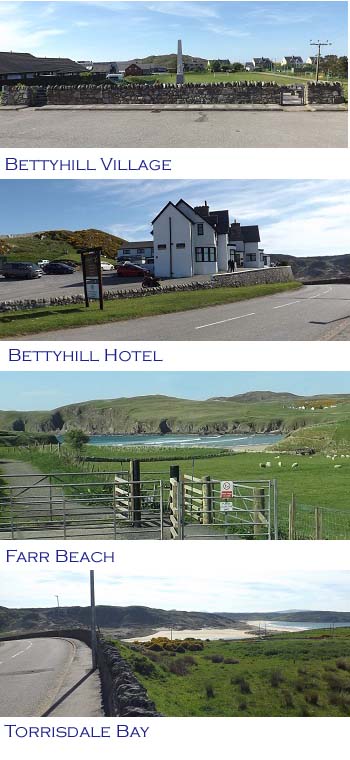
The image second top is of the the Village
Car Park, War Memorial, and Playing Field.
The Bettyhill Hotel
is across from the car park, sitting high above
Torrisdale Bay with sea views.
Bettyhill Caravan
and Campsite is about 200 yards east of the
hotel.
Farr Beach is on the east side of the
village, often with waves ideal for surfing,
has a car park at the path down to the
beach.
The Farr Bay Inn is
close to Farr Beach.
The Strathnaver Museum is
just east of Farr Beach by the Farr Bay Inn.
The Museum gives information on Vikings in the
area from the 800s - 1200s, Clan Mackay from
the 1300s - 1800s when Townships and Small
Scale Farming were a way of life, the
Sutherland's from the early 1800s, and the
Clearances of the people from the early
1800s.
The Museum is in the former Farr Church from
1774.
Torrisdale Bay with a vast Beach is on the
west side of the Village. This Beach can be
reached by a 5 mile walk out, round, and back.
Walk
Information.
You can drive down through the village to
the real small Bettyhill Harbour from where you
get great views of Torrisdale Bay, you may be
able to paddle across from the Harbour area
during a low tide, a great spot for an
inflatable Kayak.
Bettyhill History
800s - 1200s - Vikings were in control of
the area.
1300s - Clan Mackay
were the largest landowners in the area after
the Vikings had been forced out.
The area held many small scale Farms and
Townships, with the Hamlet here on the coast
known as Farr.
Townships were where a number of families
shared land for growing crops and rearing
animals from the 1100s up to the 1800s.
1774 - Farr Old Church was built.
1800s early - Clan Mackay sold much of their
land to the Countess of Sutherland.
1800s early - the Countess of
Sutherland began clearing small scale
farmers from the land to make way for large
scale sheep farming.
1800s early - the earliest parts of
Bettyhill Village were built for Elizabeth
Leveson-Gower / Countess of Sutherland next to
Farr. The village was named after
Elizabeth.
Many Farmers were encouraged to move to
coastal villages to try and live off the sea by
fishing. Others were forced south into large
towns and cities to work in industry, or even
to emigrate to America and Canada.
Other Farmers were given small plots of land
in rocky areas to live on that became known as
Croft's.
1819 - the earliest parts of Bettyhill Hotel
were built as a Travelers Inn for the
Sutherland's, probably used for trading boats
and people traveling by land with pack
horses.
1890s - the first basic road was completed
between Durness on the west coast and Thurso
close to the east coast, passing through
Bettyhill, part funded by the Sutherland's.
Roads before this time were footpaths, peat
bogs, and dangerous river crossings.
1909 - Bettyhill Church of Scotland was
built by Thomas Telford, funded by the State
and the Sutherland's.
1930s - the Sutherland's began selling off
land in the Bettyhill area. Cheep imports of
Lamb from Australia from the 1880s and Land
Reforms led to large sheep farms in the
Highlands becoming un-profitable. The
Sutherland's land in the area soon decreased
from over 1 million acres down to about 380,000
acres.
1970s - Farr Old Church was converted to the
Strathnaver Museum.
1983 - the Farr Bay Inn opened in a former
Manse from 1819.
Today - the road around the north of
Scotland passing through Bettyhill is known as
the North Coast 500 with vast numbers of cars,
motorbikes, and camper vans traveling around
all year for the amazing views and beaches.
The North Coast 500 route was launched in
2015 by the North Highland Initiative,
exceeding all expectations of how popular it
would become.
2025 - Bettyhill Church of Scotland was put
up for sale, may be converted to a home.
|